AiDA: AI in Discharge Assistant
UCSC x Accenture Capstone Project
2026
The Hidden Crisis in Healthcare
Hospital discharge is chaotic. Nurses are the connective tissue holding it all together, navigating fragmented data, multiple communication systems, and complex interdepartmental coordination. The result: heavy administrative and cognitive burden, operational delays, and increased risk of patient safety issues. "The nurse is kind of the glue that puts all of the care together," one participant told us. Yet existing systems force them to work against the workflow, not with it.
Understanding the Problem
Semi-Structured Interviews
5 healthcare professionals: 3 RNs, 1 CNA, 1 care coordinator (45–60 min each on Zoom)
Thematic Analysis
Affinity mapping to surface core pain points across roles and workflows
Persona Development
Created Emily Chen, our primary persona, from research clusters
Journey Mapping
Plotted emotional highs/lows across the discharge process to identify intervention points
Three Critical Insights
Manual Data Reconstruction
Nurses manually cross-reference multiple EMR tabs because patient information is scattered, forcing them to mentally reconstruct timelines and increasing cognitive load by 30–50%.
Communication Fragmentation
Asynchronous, multi-platform communication across teams (doctors, case managers, transport) means nurses spend hours tracking down status updates instead of caring for patients.
Alert Fatigue & Documentation Clutter
Constant false alarms and slow, unreliable logging systems dull clinical judgment. Nurses miss critical warnings in the noise.
AiDA: The Concept
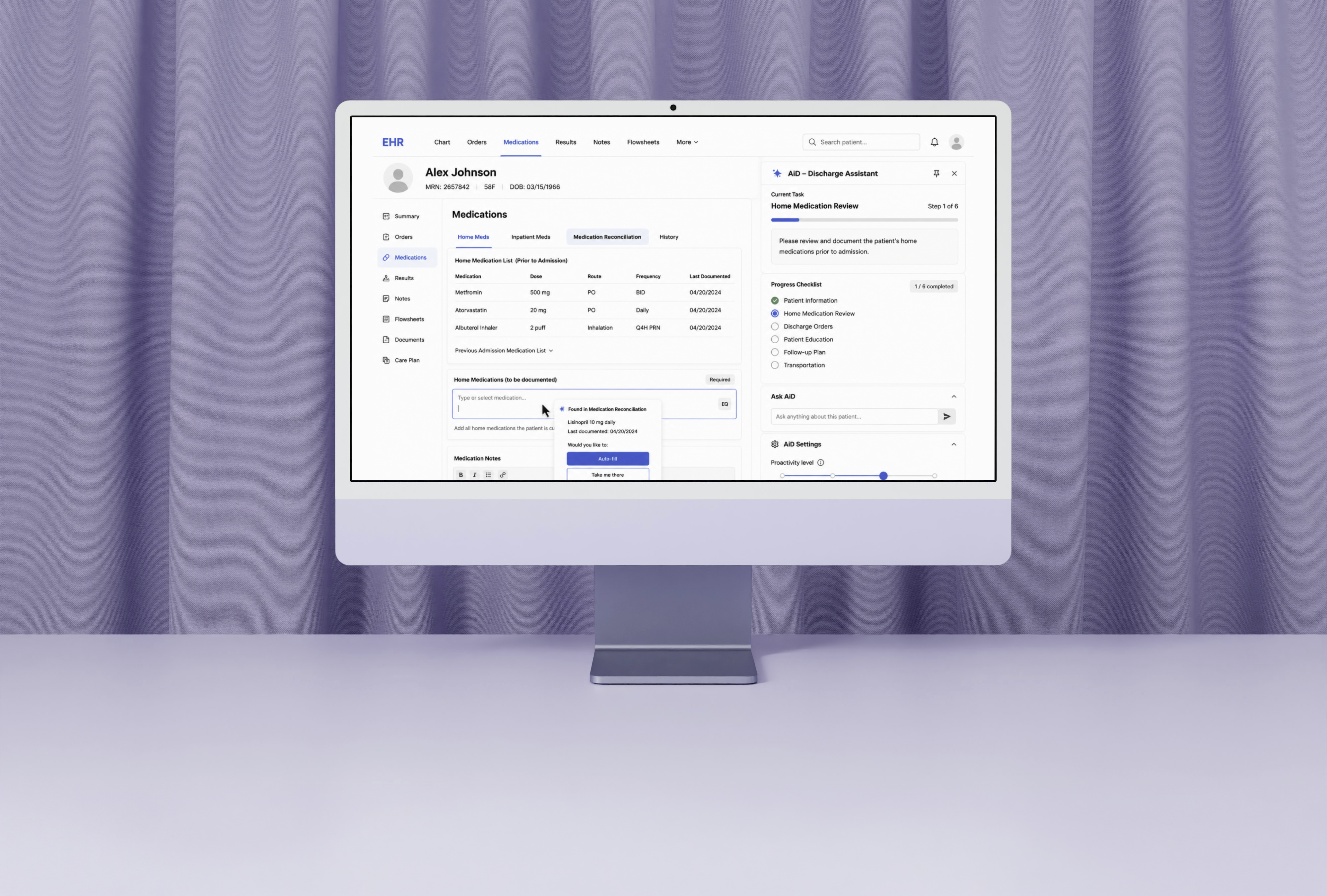
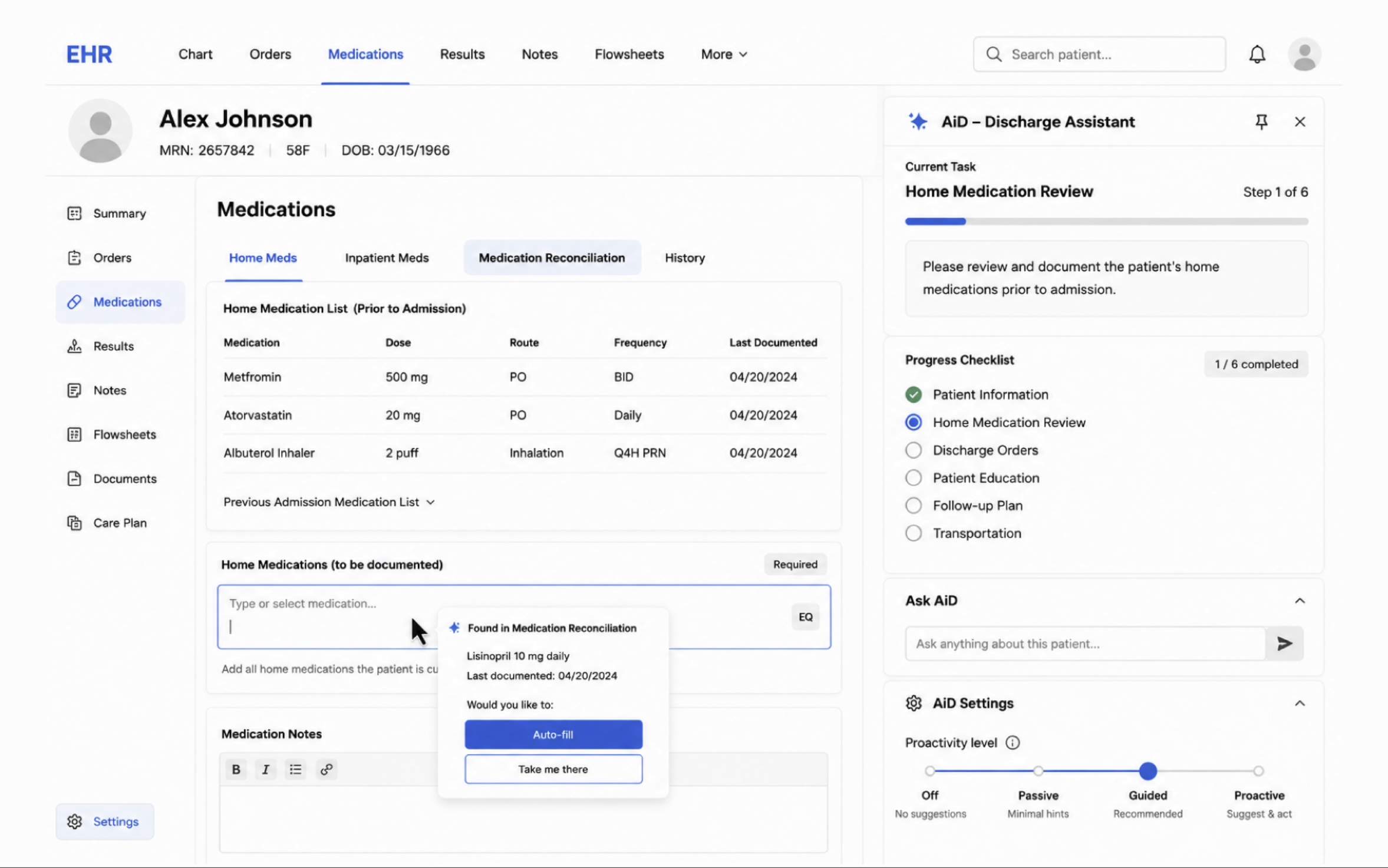
An AI-guided cursor embedded within the existing EHR system that understands where nurses are in the discharge workflow and proactively guides them to the right information. Rather than adding another tool, AiDA augments the current system, preserving user control while reducing the friction of navigation. Three key components work together: an AI guidance cursor highlighting correct tabs and fields, a suggestion card offering contextual assistance, and a progress tracker that shows workflow completion in real time.
The Core Innovation
Workflow awareness. AiDA doesn't just respond to isolated prompts. It recognizes discharge stage transitions, understands which information is needed at which step, and surfaces risks before they become problems. AI that adapts to how real work actually progresses.
Three Interaction Patterns
AI-Guidance Cursor
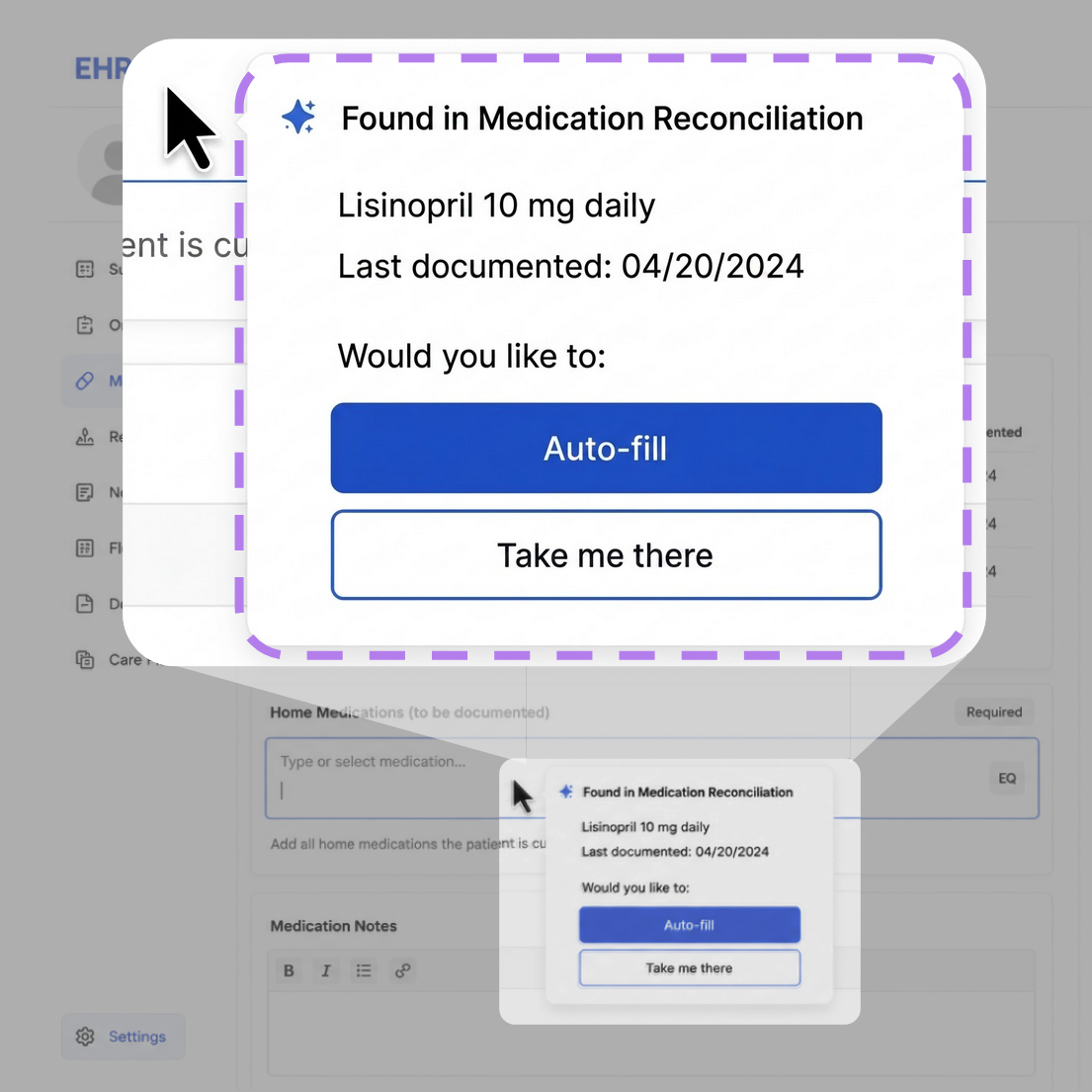
Visually highlights the correct tabs, fields, or workflow steps. Helps nurses navigate fragmented systems without mental overhead.
Suggestion Card
Provides context-aware assistance: "Found in Medication Reconciliation (Last documented 04/20/2024)." Offers quick actions like "Auto-fill" or "Take me there."
AI Tracker Panel
Real-time progress checklist showing discharge milestones: patient info, home meds, discharge orders, patient education, follow-up plan, transportation. Updates automatically.
Visual & Emotional Design
The design language prioritizes feelings of confidence, support, and calm. We chose blue and teal to evoke reassurance, rounded forms to encourage vulnerability, and kept the UI clean to avoid adding to alert fatigue. The goal is to help nurses feel guided, not burdened.
The Research Process
- Started with an open-ended brief: what if AI understood workflow and adapted its behavior?
- Pivoted from enterprise healthcare to clinical discharge after recruiting challenges, but maintained the core theme: multi-stakeholder workflows + administrative complexity.
- Conducted rapid literature review on workflow-aware systems, healthcare compliance, and cognitive load.
- Used affinity mapping and persona synthesis to translate raw insights into design requirements.
- Grounded every design decision in research evidence with no assumptions.
How AI Supported Development
We used AI to speed up synthesis and concept exploration by comparing workflow patterns, pressure-testing interaction ideas, and drafting alternative guidance states for the EHR experience. That let us move quickly without losing the healthcare context from interviews and affinity mapping.
The biggest impact was on the people doing the work: nurses, care coordinators, and patients. By using AI to narrow the design space faster, we focused the solution on reducing context switching, unnecessary handoffs, and discharge delays instead of adding another layer of complexity.
What's Next (Quarter 2)
High-fidelity wireframes in Figma (Weeks 1–2), usability testing with nurses using think-aloud and A/B testing (Weeks 3–6), and functional prototyping with Figma and Claude Code (Weeks 6–10). Success metrics: over 90% task completion, 20–30% faster discharge time, over 70% user satisfaction.
Impact
Nurses and care coordinators could spend less time chasing information and more time on patient care.
The Team
Andrew Petersen
UX Research
Tereese Bangayan
UX Research
Christine Ko
Design
Lilian Mathis
UX Research
Ian Phan
UX Research